Agents on a call get a suggested answer from past tickets, the knowledge base and the caller's orders
While a customer talks, an assistant in Zendesk finds the caller's order in Unicommerce, the rule in Confluence and how past tickets were solved, and suggests what to say. The agent decides.
- Used day to day by
- Customer service agents
- Support team leads
- Customer service head
What the assistant uses here
Answers from your systems, within each person's access.
- Your approval Acts in your systems only after a person approves
How it runs with AI
While the customer talks, an automated assistant in Zendesk follows the call. It finds the caller's order in Unicommerce from the calling number, checks the rule in Confluence and reads how past tickets with the same fault were solved. A suggested answer appears on the agent's screen within seconds, with each source named, and the agent can ask it a follow-up in plain words. The agent decides what to tell the customer.
How the assistant works here
Where people ask, what it draws on, and what comes back.
Where people ask
-
 Exotel, steps 1 and 2
Who asks
- Customer service agents
- Support team leads
- Customer service head
What it draws on
Apps
-
 Zendesk, steps 4 and 5
 -
 Unicommerce, steps 2 and 5
 -
 Confluence, steps 3 and 4
Context
- Product list, step 1
- Usual reasons for calls, step 1
- Past orders by customer, step 2
- Sales channels, step 2
- Returns policy, step 3
- Warranty terms by product, step 3
- Past fixes by fault, step 4
- Agent approval limits, step 4
What comes back, and who decides
- An answer with its sources, step 4
Who decides
- Decides what to offer the customer, such as a free part, a visit or a return, step 5
How a request runs
-
Step 1, the assistant: Follows the call as the customer speaks and picks out her question
-
Step 2, the assistant: Finds the caller's order in Unicommerce from the calling number
Exception Asks the agent to check the order number with the caller when the number matches no order
-
Step 3, the assistant: Checks the returns and warranty rules in the Confluence knowledge base
-
Step 4, the assistant: Reads how past tickets with the same fault were solved, suggests what to say and answers the agent's follow-up questions
- Person
Step 5, a person: Decides what to offer the customer, such as a free part, a visit or a return
The same flow works with the apps you use.
Who controls it
-
Access
It runs with each person's own access, so it shows only what they could open themselves
-
Approvals
The assistant suggests and the agent decides. Refunds and credits above an agent's limit go to a team leader, and the assistant tells the agent so
-
Record
Every question, source, action and approval is recorded
This fits you if
- Your agents take more than 2,000 calls a month
- Callers wait on hold while the agent looks up the order or the policy
- Orders from your website and marketplaces sit in Unicommerce
- Your rules and fixes are written up in Confluence, and solved tickets sit in Zendesk
What to watch for
- It shows the agent only the calling customer's orders, found from the number on the call. When the number matches no order, the agent checks the order number with the caller first
- Your call greeting tells callers that calls are recorded and transcribed
- It suggests only from published pages in Confluence and solved tickets in Zendesk, so team leaders update a page on the day a rule or a fix changes
- Team leaders review a sample of suggestions each week in the first month, and correct any page or past ticket that leads to a wrong suggestion
Often done together
Customer service Incoming queries
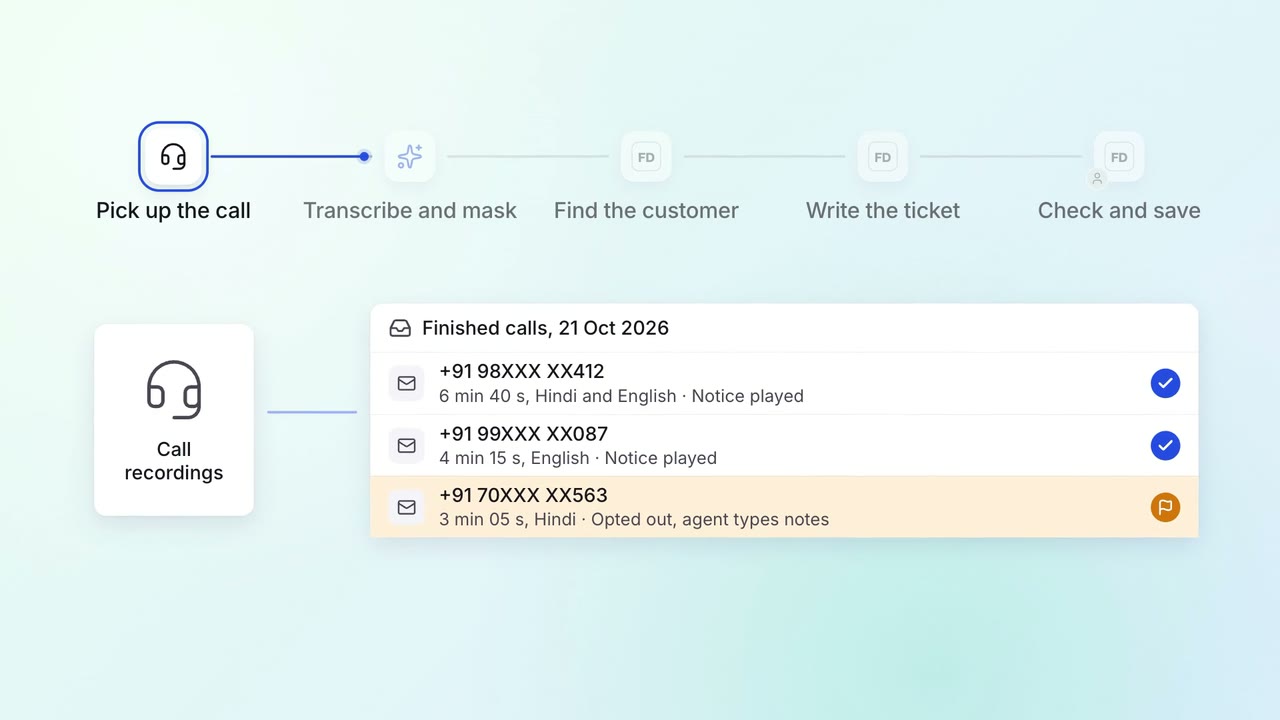
Every service call becomes a ticket with a summary and the next step
- Call recordings
 Freshdesk
 Company assistant
Customer service Incoming queries
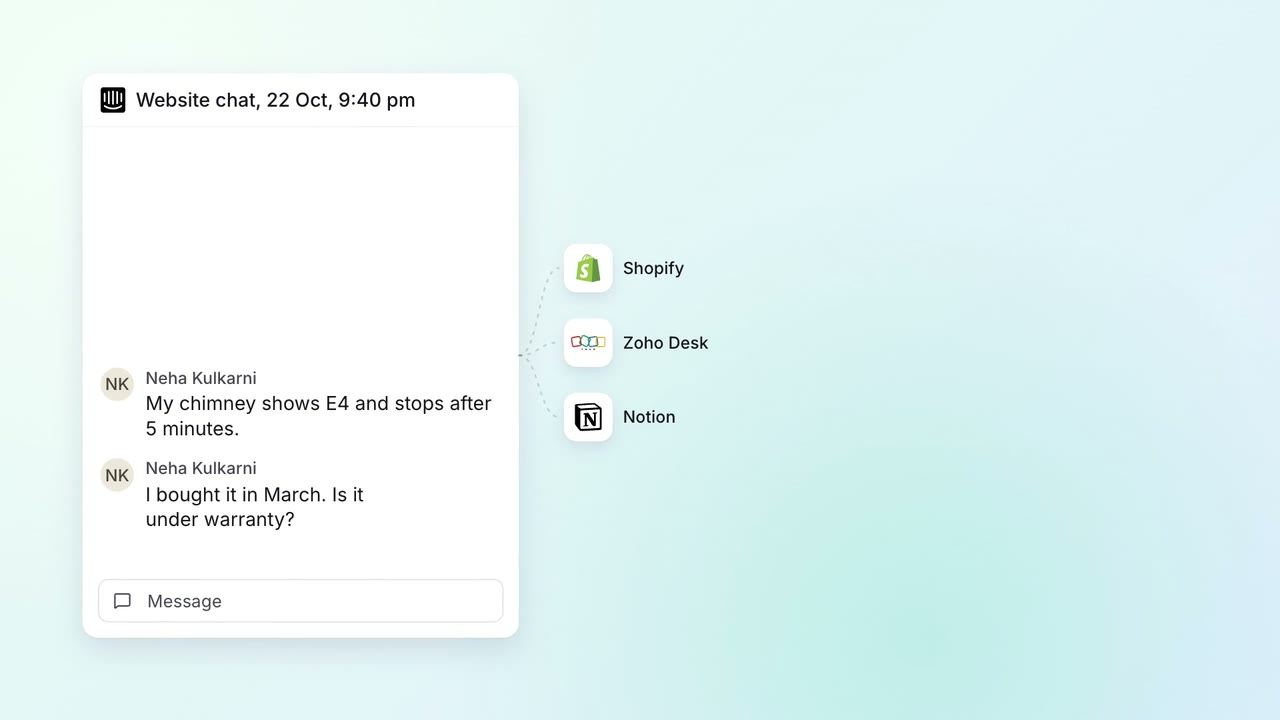
Website chat answers from manuals, orders and warranty records, and hard cases reach an agent
 Intercom
 Shopify
 Zoho Desk
 Notion
Customer service Help articles
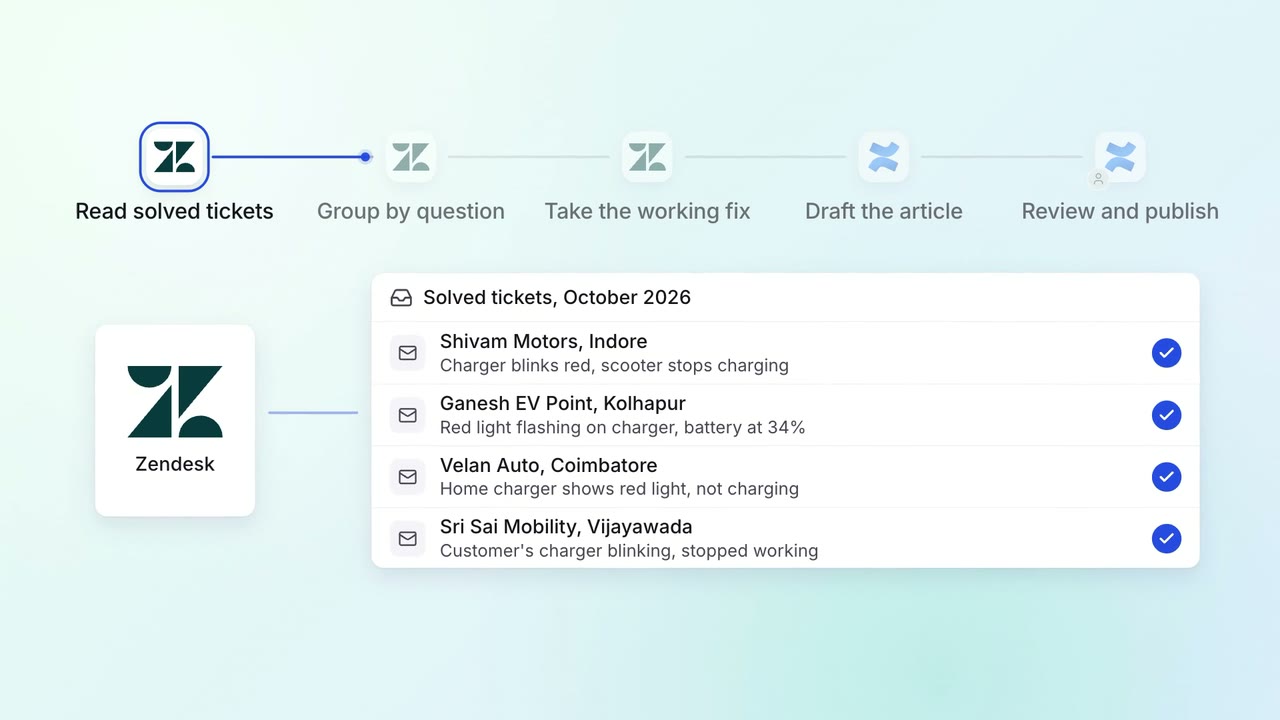
Solved tickets become help articles, so each question gets answered once
- Zendesk
- Confluence